
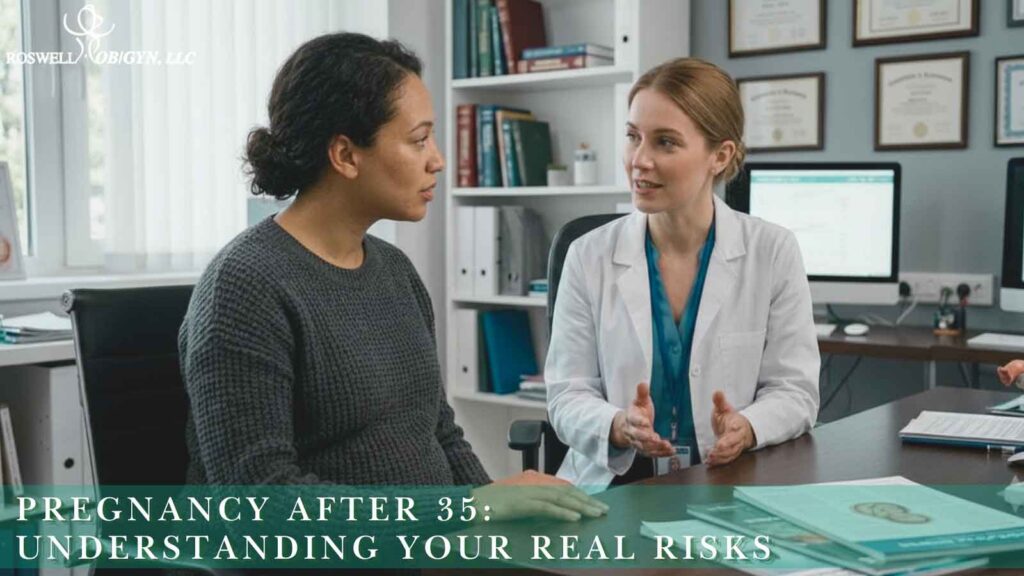
Pregnancy after 35 is more common than ever, and most pregnancies in this age group end with a healthy mother and a healthy baby. The medical term for becoming pregnant at 35 or older is advanced maternal age (AMA), a label that focuses on risk percentages rather than realistic outcomes. Some risks do increase modestly with age, including chromosomal differences, gestational diabetes, and preeclampsia. The absolute rates for serious complications still remain low, especially with personalized prenatal care. Our team supports patients across the full spectrum of obstetric care, from routine low-risk pregnancy to high-risk pregnancy management, and this guide breaks down what age 35 actually means for your pregnancy and how good care narrows the gap between perceived risk and real outcome.
What Does “Advanced Maternal Age” Mean?
Advanced maternal age is the term obstetricians use for women who will be 35 or older at their estimated delivery date. The cutoff was set decades ago because that is roughly where the statistical risk of certain complications begins to climb in a measurable way. It does not mean your pregnancy is automatically high risk, only that your provider will pay closer attention to a few specific areas.
The label can feel heavier than it should. A 36-year-old in excellent health with no chronic conditions and a healthy lifestyle is in a very different situation than a 36-year-old with uncontrolled diabetes or hypertension. Your provider looks at your whole picture, not just the number on your driver’s license, when planning your care.
What Are the Real Risks of Pregnancy After 35?
Several pregnancy complications occur slightly more often in patients age 35 and older. Understanding the actual numbers helps replace anxiety with informed decision-making.
| Complication | Risk Under 35 | Risk After 35 | Key Takeaway |
| Down syndrome | About 1 in 1,200 at age 25 | About 1 in 350 at age 35, 1 in 85 at age 40 | Still uncommon; screening detects it early |
| Gestational diabetes | About 7 to 10% of pregnancies | Roughly double in women over 35 | Diet, exercise, and monitoring manage it well |
| Preeclampsia | About 3 to 5% | About 5 to 10% | Blood pressure tracking catches it early |
| Cesarean delivery | Lower baseline rate | Modestly higher | Vaginal birth is still common |
| Miscarriage | About 10 to 15% | About 20% at 35, climbing with age | Often related to chromosomal factors |
These numbers describe averages across large populations, not individual outcomes. A 38-year-old in good health may have lower risk than a 28-year-old with multiple medical conditions. Numbers guide care, they do not define a pregnancy.
Why Risks Change with Age
A few biological factors explain the increase in complication rates over time. Egg quality gradually declines starting in the early 30s and drops more sharply after 35, which contributes to higher rates of miscarriage and chromosomal differences. Blood vessels, the cardiovascular system, and metabolism all change subtly with age, which is why preeclampsia and gestational diabetes become slightly more common. Existing health conditions, even mild ones, also tend to add up over time.
None of these changes are dramatic on their own. Pregnancy after 35 is not fundamentally different from pregnancy in your late 20s, the risk numbers just shift a little. Modern obstetrics is built to identify and manage those shifts early.
How Prenatal Care Changes After 35
Care for pregnancy after 35 usually includes a few extra layers of monitoring designed to catch problems before they become serious. You can expect:
- Earlier and more thorough screening. Noninvasive prenatal testing (NIPT) is a simple blood test that screens for Down syndrome and other chromosomal differences as early as 10 weeks, with very high accuracy.
- Nuchal translucency ultrasound between 11 and 14 weeks to evaluate early fetal development.
- More frequent blood pressure checks to detect preeclampsia in its earliest stages.
- Earlier glucose testing for gestational diabetes, sometimes in the first trimester rather than waiting until the standard 24 to 28 week window.
- Additional growth ultrasounds in the third trimester to track placental function and fetal growth.
- Fetal monitoring in the final weeks, including nonstress tests and biophysical profiles when indicated.
- Closer attention to chronic conditions like high blood pressure, thyroid disorders, and diabetes throughout pregnancy.
This added monitoring is reassuring rather than alarming for most patients. It gives you and your provider more information at every step. You can read more about what to expect during a high-risk pregnancy post.
How to Prepare for a Healthy Pregnancy After 35
A few months of preparation before conception can meaningfully reduce risk for pregnancy after 35. Practical steps include:
- Schedule a pre-conception visit with your OBGYN to review your medical history, medications, and family history
- Get any chronic conditions like hypertension, diabetes, or thyroid disease into well-controlled territory before conceiving
- Start a prenatal vitamin with folic acid at least three months before trying, to lower the risk of neural tube defects
- Reach a healthy weight if possible, since both underweight and overweight ranges affect pregnancy outcomes
- Stop smoking, vaping, and recreational drugs completely, and limit alcohol
- Talk to your provider about any prescription medications that may need to be changed
- Update vaccinations including flu, Tdap, and any others your provider recommends
- Limit caffeine to under 200 mg per day
- Address dental health, since gum disease has been linked to preterm birth
These steps apply to anyone planning a pregnancy, and they matter even more after 35 because the margin for catching problems early is smaller. Our taking early action to avoid a high-risk pregnancy article expands on each of these areas.
The Often Overlooked Advantages
The conversation around pregnancy after 35 tends to focus on risk, but many older parents bring real strengths to the experience. Patients in their late 30s and early 40s often have:
- More stable careers and income
- More established relationships and support systems
- Stronger health literacy and better insurance coverage
- More experience advocating for themselves with providers
- Greater emotional readiness and patience
- A clearer sense of their priorities and values
Several large studies have found that children born to older mothers, on average, have higher academic and developmental outcomes, likely linked to these socioeconomic and parenting factors. The right age for pregnancy depends on far more than a single number.
When Should You Talk to Your OBGYN About Pregnancy After 35?
The right time to start the conversation is before you start trying to conceive, ideally three to six months ahead. You should book a pre-conception visit if you:
- Are 35 or older and considering pregnancy
- Have a chronic medical condition such as diabetes, hypertension, thyroid disorder, or autoimmune disease
- Have had a prior miscarriage, preterm birth, or pregnancy complication
- Have a family history of genetic conditions
- Take prescription medications and want to review safety before pregnancy
- Have been trying to conceive for six months without success at age 35 or older, or three months at age 40 or older
A pre-conception visit takes about 30 to 45 minutes and gives you a personalized roadmap. You can read more about what your first OB visit involves on our information for pregnant patients page.
Schedule Your Pregnancy Consultation at Roswell Ob/Gyn, LLC
Pregnancy after 35 deserves thoughtful, personalized care, not generic worry. The team at Roswell Ob/Gyn, LLC provides pre-conception counseling, routine prenatal care, high-risk pregnancy management, advanced screening including NIPT, and in-office ultrasound across our Alpharetta, Atlanta, Canton, and Cumming locations. Your provider will spend the time to understand your full medical and personal history before recommending the right plan.
Ready to take the next step? Request your appointment online or call our office today to schedule pre-conception planning, your first OB visit, or a second opinion on your current care.
Frequently Asked Questions
Is 35 really a magic number for pregnancy risk?
No. The number 35 was chosen because that is roughly where statistical risk begins to rise in a measurable way, but the increase is gradual rather than sudden. A 35-year-old and a 34-year-old have nearly identical risk profiles. The shift becomes more meaningful in the late 30s and early 40s.
Can I have a vaginal birth after 35?
Yes. Many women have healthy vaginal births well into their late 30s and 40s. C-section rates are modestly higher with age, often related to longer labors, induction for medical reasons, or complications that develop during pregnancy, but vaginal birth remains the goal whenever it is safe for both parent and baby.
What is NIPT, and do I need it after 35?
Noninvasive prenatal testing (NIPT) is a blood test that screens for Down syndrome and other chromosomal differences using fetal DNA circulating in the parent’s blood. It is highly accurate and can be done as early as 10 weeks. NIPT is commonly offered to patients age 35 and older, but it is also available to younger patients who want the information.
Does pregnancy after 35 affect my baby’s health?
Most babies born to mothers age 35 and older are healthy. The risk of certain conditions, including chromosomal differences and being born preterm or small for gestational age, is modestly higher, but the absolute risk remains low. Good prenatal care, screening, and lifestyle choices have a much larger impact on outcome than age alone.
How long should I try before seeking fertility help after 35?
Most obstetric organizations recommend seeking a fertility evaluation after six months of trying at age 35 or older, and after three months at age 40 or older. Earlier evaluation is reasonable for anyone with known risk factors such as irregular cycles, endometriosis, or prior pelvic surgery.